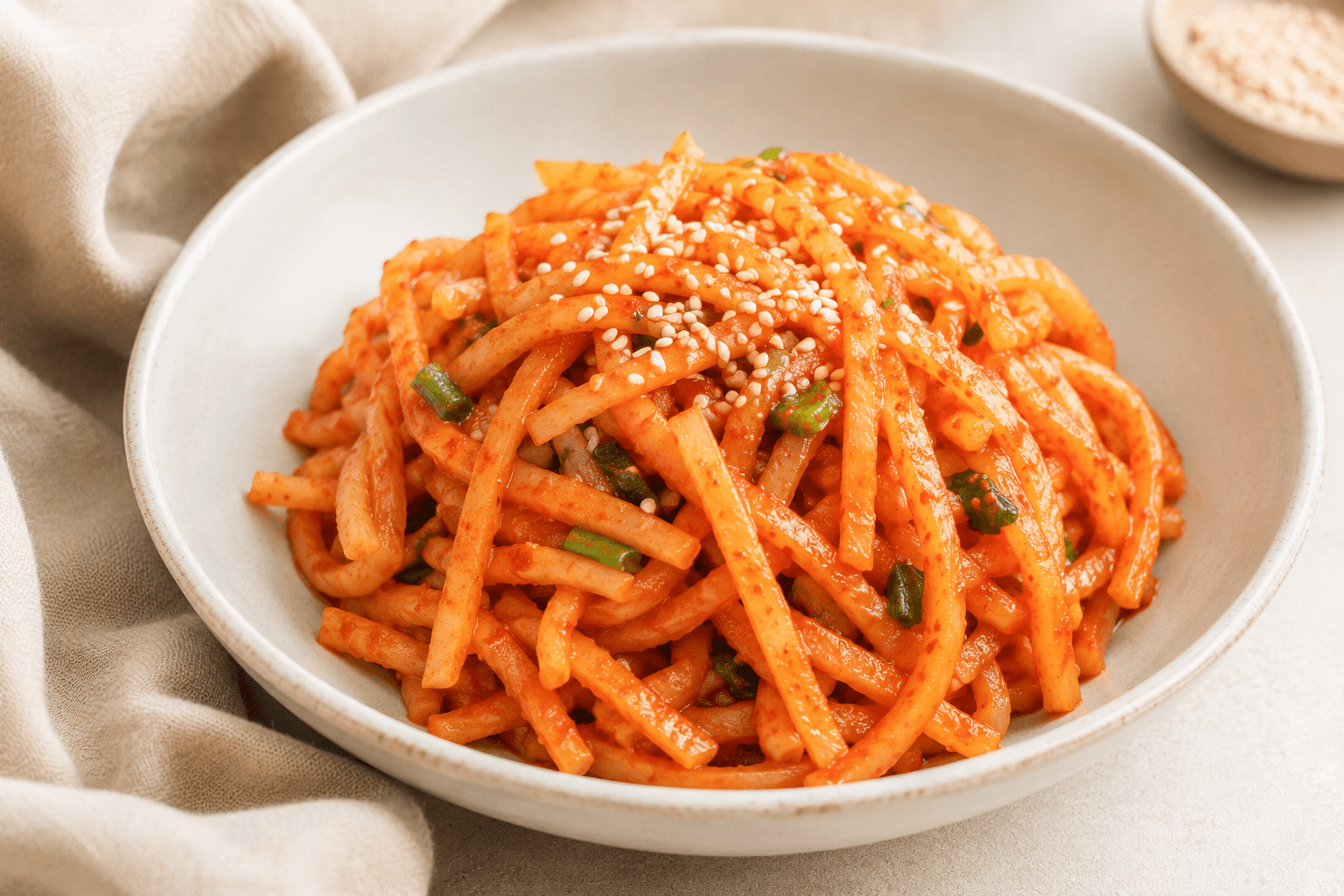
Musaengchae (Korean Spicy Radish Salad, 무생채)
A simple musaengchae recipe with radish, gochugaru, vinegar, soy sauce, and fish sauce. Korean spicy radish salad as a side dish or fresh bibimbap topping.
My notes for this recipe
Musaengchae is a Korean radish salad with a sweet, sour, and slightly spicy seasoning. I especially like it as a fresh topping for bibimbap because it adds a crisp and juicy contrast to the cooked vegetables.
Daikon, white radish, or Korean radish can all be used. Korean radish is usually firmer and slightly sweeter, but daikon is a practical substitute. The most important thing is to cut the radish into thin, even strips so it absorbs the seasoning well.
This version has a fairly bold flavor. For a milder salad, start with less gochugaru, soy sauce, or fish sauce and adjust at the end. You can also use maesil-cheong, Korean plum syrup, instead of sugar.
How I cook it
Peel the radish or wash it well. Cut it into thin strips about 0.2–0.3 cm thick.
Slice the green onion into small rings.
Place the sliced radish in a large bowl. Add sugar or maesil-cheong and mix briefly.
Add gochugaru, vinegar, soy sauce, and fish sauce. Mix gently but thoroughly until the radish is evenly coated and red.
Add the green onion and mix once more.
Let it sit briefly and taste. If the seasoning is too strong, add a little more radish. If it tastes too mild, adjust with a little gochugaru, vinegar, or soy sauce.
Serve as a side dish or use it as a fresh topping for bibimbap.
What to cook next
Share this recipe
Share the link, a short introduction or an image made with the existing recipe photo.
Prepare a Pinterest Pin
Download the image, then paste the title, description and link into the matching fields of a new Pin.
Review the text and choose a suitable board. If the original photo was made or edited with AI, mark it as AI-modified when publishing.